If you are starting a new FiveM roleplay server in 2026, the short answer is this: choose ESX Legacy for the largest library of ready-made scripts, or Qbox for modern architecture and better defaults — QBCore is no longer the first pick for a server built from scratch, because its development has visibly slowed. That said, the framework choice matters less than most server owners assume: your server's performance is determined far more by the scripts you load on top and by the clock speed of the processor underneath. This guide covers the real differences between the three, which one fits which situation, and what to watch when migrating.
A FiveM framework is your server's skeleton: it handles player identity, characters, money, jobs, inventory and the database layer. Every script you install plugs into that skeleton.
Which makes the framework choice less a technical decision than an ecosystem decision. It determines which ready-made scripts you can install, how easy it is to find a developer, and whether you will still be getting updates two years from now.
All three share the same requirement: a MySQL or MariaDB database with the oxmysql connector. So on the database side, setup is similar whichever you pick.
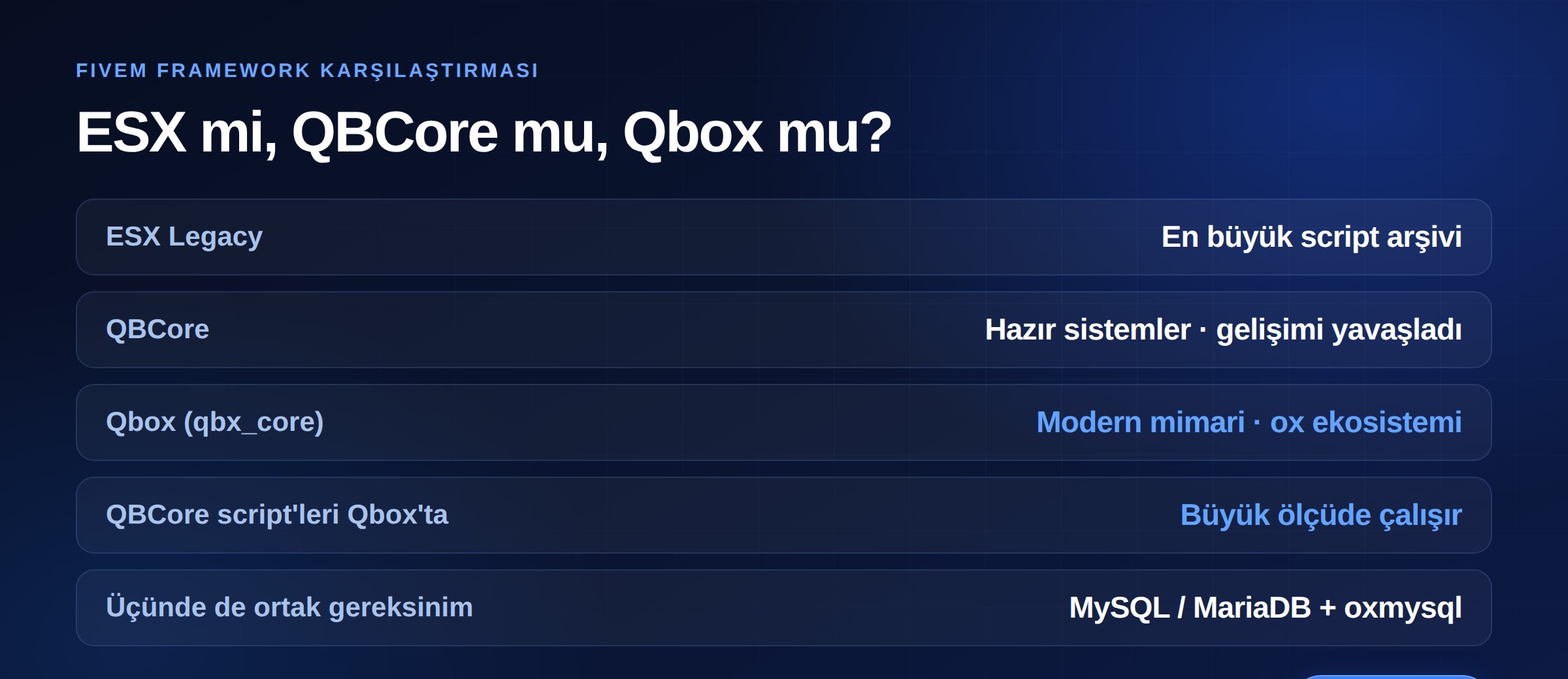
ESX is the oldest and most widely used framework in the FiveM roleplay scene, currently maintained as ESX Legacy.
Best for: First-time server owners, anyone wanting to draw on an abundance of cheap ready-made scripts.
QBCore emerged to fill the gaps ESX left, and spread quickly by shipping inventory, targeting and weather systems out of the box.
Best for: Servers already running on QBCore with significant script investment. No longer the first choice for a new build.
Qbox launched in September 2022 as a fork of QBCore, with its purpose stated plainly in the official documentation: improving upon QBCore while maintaining backwards compatibility. The core resource is named qbx_core.
ox_lib, ox_inventory, oxmysql — by default, which removes the most common beginner mistake of picking poor add-ons. (The Qbox team notes it is not affiliated with Overextended and simply uses their resources.)Best for: Servers built from scratch in 2026, and QBCore teams looking for long-term maintenance.
The CPU comparisons circulating online contradict each other. Some sources report Qbox using 25–40% less CPU than QBCore depending on load and script count; another comparison measuring at idle puts ESX lowest, QBCore highest and Qbox between them.
That contradiction is not an error — it is a difference in measurement conditions. And the important point is this: idle framework consumption does not determine a live server's performance. On a 40-player RP server, what eats CPU is not the framework core but the 80–150 resources loaded on top of it.
The right approach:
resmon and profiling tools, against your own script set.FiveM runs largely on a single thread. That is structural and applies whichever framework you choose, and the consequence is simple: clock speed matters more than core count.
In practice, a current-generation processor above 4.5 GHz with a large L3 cache delivers noticeably better tick times than an older many-core server. RAM needs by concurrent players run roughly:
An empty FiveM server uses around 2–3 GB; the rest is your loaded resources. We covered per-game sizing in detail in our game server hosting guide.
Changing the framework on a running server is not a small job. Judge it on these criteria:
If you decide to go ahead, the order is: full backup first (database plus server directory), then install on a separate test server, then move scripts across one at a time and verify, then cut over. Never upgrade framework and version at the same time; when something breaks you will not be able to tell which caused it.
Regardless of framework, your infrastructure needs these in place:
oxmysql connection — all three frameworks require it.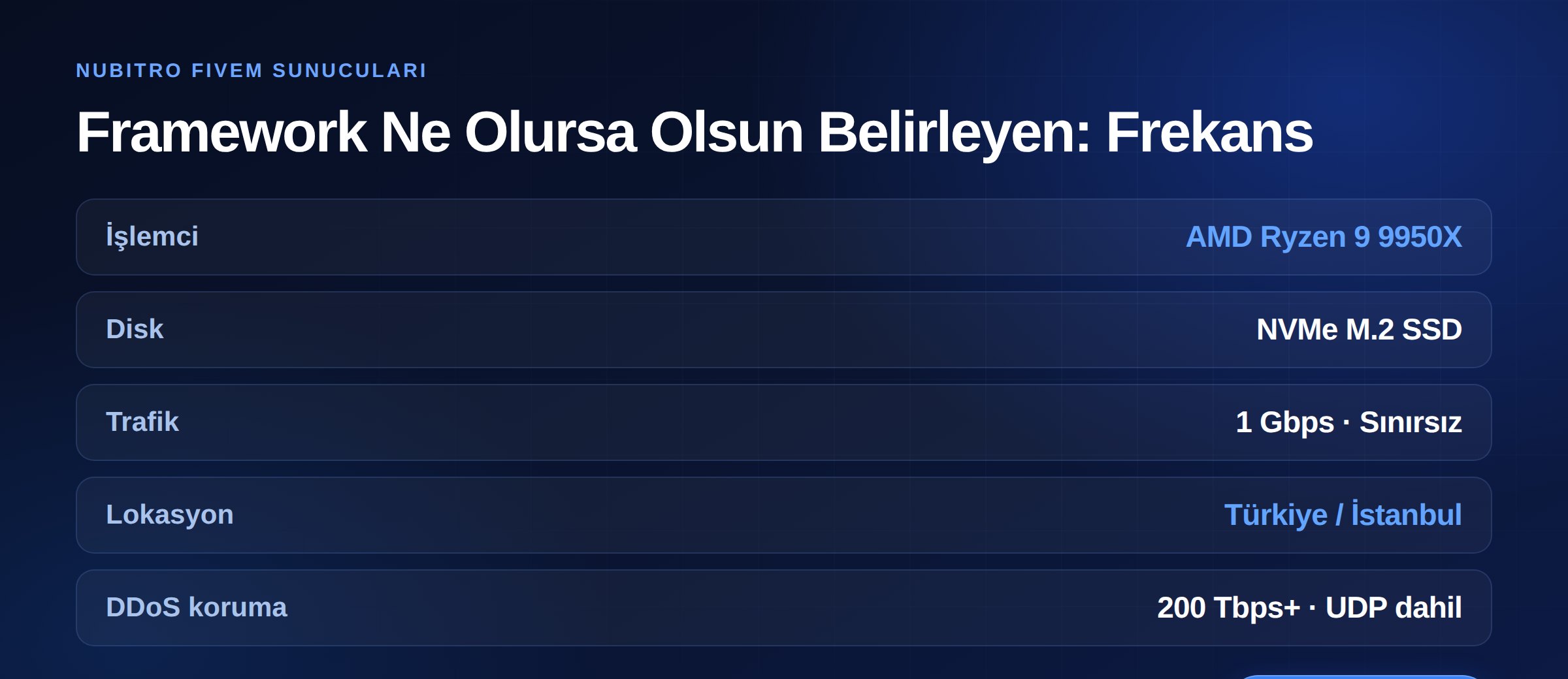
Whichever framework you choose, tick time in FiveM is decided by single-thread performance. Nubitro servers run on AMD Ryzen 9 9950X processors in Istanbul, Turkey, with NVMe M.2 SSD storage and 1 Gbps unmetered traffic. The infrastructure carries 200 Tbps+ DDoS protection as standard.
Because resources are assigned through hardware partitioning, neighbour load does not reach your tick time — the source of the consistency that matters more than average speed on an RP server.
Review the plans on our FiveM server hosting page, or see Ryzen VDS if you want to build your own configuration. For everything else, visit the Nubitro homepage.
ESX Legacy if you want an abundance of ready-made scripts and the easiest learning curve; Qbox if you want modern architecture, better default dependencies and active maintenance. QBCore is no longer the first pick for a fresh build given its slowed development.
According to Qbox's documentation, almost all QBCore scripts run without modification, with the exceptions listed in its FAQ. Still, verify each script on a staging server before going live.
Technically yes, but it is not simple: the data structures differ, so player, inventory and job data all have to be converted. On an established server with a large player base this can be a multi-day project. If you are still planning a new server, deciding up front is far cheaper.
Only marginally. On a live server, CPU is consumed by loaded scripts, not the framework core. Measure with resmon first to find which resource is eating tick time — usually it is one specific script.
In idle measurements ESX is lowest and QBCore highest, with Qbox in between. But those are empty-server figures and do not represent real load. Do not decide without measuring against your own script set.
Not directly. What decides is your player count and how many resources you load. A mid-sized 30–64 player RP server wants 12–16 GB of RAM and a high-clocked processor regardless of framework.
oxmysql.qbx_core. Turkey (Türkçe)
 Worldwide (English)